
Reviewed by Adrianos Facchetti, Esq. California State Bar No. 243213. This article was reviewed for legal accuracy and general informational value. You can verify this attorney’s license status through the California State Bar attorney search.
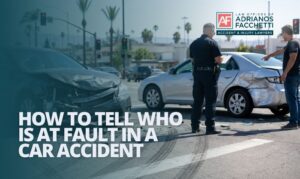
How to Tell Who Is at Fault in a Car Accident
Fault in a California car accident is usually determined by looking at traffic law violations, the physical evidence at the scene, witness statements, the police report, and any available video footage. No single piece of evidence automatically decides fault on its own. Instead, all of it gets weighed together to answer one core legal question: whose failure to act with reasonable care actually caused the crash.
This isn’t always as obvious as it sounds. Two drivers can walk away from the same accident with genuinely different accounts of what happened, and insurance companies sometimes reach conclusions that don’t match what a closer investigation would show. If you were just in a crash and you’re trying to understand who’s actually responsible, this article walks through how fault really gets determined in California and what to do if you’re already being blamed.
If you’re dealing with a disputed fault situation right now, our Los Angeles car accident lawyer team can review the evidence and help sort out what actually happened.
Who Decides Fault After a Car Accident?
There isn’t one single authority who makes a final, binding fault determination right after a crash. Several different parties may form an opinion about fault, and they don’t always agree.
The police officer at the scene may note contributing factors, issue a citation, and record statements in the collision report. This is useful information, but it’s not a legal finding of fault in a civil case.
Insurance adjusters review the available evidence and make their own fault determination for the purpose of deciding whether and how much to pay. Their conclusion is based on their own investigation and their own financial interest in the outcome.
Your own attorney, if you hire one, investigates independently and builds an evidentiary case that may reach a different conclusion than either the police report or the insurance company’s initial assessment.
A court, if the case goes to litigation, makes the final legal determination of fault based on the evidence presented, under standards like California Civil Jury Instructions (CACI) No. 401, which addresses the basic standard of care a driver owes.
In most cases, the claim resolves through negotiation before ever reaching a courtroom, which means the insurance company’s fault assessment often functions as the practical starting point, even though it isn’t the final legal word.
Key Evidence Used to Determine Fault
Fault gets built from a combination of evidence types, and the strength of a case usually comes from how well these pieces fit together, not from any single item.
- Traffic law violations. Whether a driver ran a red light, failed to yield, made an unsafe lane change, or violated another provision of the California Vehicle Code
- Vehicle damage. The location, angle, and severity of damage on both vehicles, which can indicate how the collision happened
- Point of impact. Where exactly the vehicles made contact, which often tells a clearer story than either driver’s verbal account
- Photos and video. Images of the scene, vehicle positions, and road conditions taken as close to the time of the crash as possible
- Police reports. Officer observations, citations issued, and recorded statements
- Witness statements. Independent accounts from people with no stake in the outcome
- Driver statements. What each driver said at the scene or in a later recorded statement
- Skid marks and road conditions. Physical evidence of braking, speed, and evasive action
- Medical records. Which can sometimes corroborate the mechanics of how a crash happened, particularly in disputed cases
- Dashcam or surveillance footage. Often the single most persuasive evidence available, since it shows what actually happened rather than relying on competing accounts
No individual item on this list “proves” fault by itself. A citation without supporting evidence can be challenged. A police report without physical corroboration can be incomplete. The strongest fault determinations come from multiple independent sources telling a consistent story.
Common Accident Scenarios and Who May Be at Fault
Fault patterns tend to follow the specific type of crash, though every case still depends on its own facts.
Rear-End Collisions
The rear driver is often presumed to bear significant responsibility, since California drivers are generally expected to maintain a safe following distance. But this presumption isn’t absolute. A sudden, unexplained stop, a brake check, or a mechanical failure in the lead vehicle can shift some responsibility.
Left-Turn Accidents
A driver turning left generally must yield to oncoming traffic. When a left-turning driver crosses into an oncoming vehicle’s path, they often bear primary fault, though the oncoming driver’s speed and attentiveness are also part of the analysis.
Lane-Change or Sideswipe Crashes
The driver changing lanes generally has a duty to ensure the lane is clear before moving. Fault in these cases often depends heavily on witness accounts and vehicle damage, since both drivers may claim the other drifted first.
Red Light and Stop Sign Crashes
A driver who enters an intersection against a red light or without stopping at a stop sign is often clearly at fault, particularly when supported by traffic camera footage, an independent witness, or a citation.
Parking Lot Accidents
These crashes often involve disputed right-of-way, since parking lots typically lack the clear signage and lane markings of public roads. Fault frequently comes down to which vehicle was already established in a traffic lane versus which was backing out of or pulling into a space.
Multi-Vehicle Crashes
Chain-reaction crashes can involve more than one at-fault party, and untangling which impact caused which specific injury or damage often requires a more detailed investigation than a two-car crash.
Pedestrian, Motorcycle, or Truck Crashes
These involve their own specific legal frameworks. Our Los Angeles pedestrian accident lawyer, Los Angeles motorcycle accident lawyer, and Los Angeles truck accident lawyer pages go into more detail on how fault gets evaluated in those specific situations, since visibility, right-of-way rules, and commercial regulations all add additional layers.
Is the Driver Who Got the Ticket Always at Fault?
A traffic citation is meaningful evidence, but it isn’t automatically the final word on fault in a civil claim.
An officer issues a citation based on what they observed or were told at the scene, often within a short window and without the benefit of a full investigation. A citation can be contested, and even an uncontested citation doesn’t necessarily account for every contributing factor in a crash. In some cases, the cited driver was genuinely the primary cause. In others, later evidence, like surveillance footage or an independent witness, tells a more complete story that shifts the picture.
Treat a citation as strong evidence worth taking seriously, not as a conclusion that ends the inquiry.
Can Both Drivers Be at Fault in California?
Yes. California follows a pure comparative fault system, which means responsibility for a crash can be divided between multiple parties based on what each one actually did.
Here’s a practical example: say a driver runs a stop sign, but the other driver was also speeding through the intersection. An insurance company or a court might determine the stop-sign driver was 70% at fault and the speeding driver was 30% at fault. Under California’s comparative fault rule, described in CACI No. 405, each party’s recovery is reduced by their own percentage of fault. This isn’t a rare exception. Shared fault situations come up regularly, particularly in intersection crashes, lane-change collisions, and multi-vehicle pileups.
How Insurance Companies Determine Fault
Insurance adjusters review the same categories of evidence described above, but they’re doing so with their own company’s financial interest in mind, not as a neutral referee.
Adjusters typically review the police report, take recorded statements from both drivers, inspect vehicle damage, and sometimes request additional documentation before reaching a fault percentage. Their conclusion determines how much, if anything, they’re willing to pay. That conclusion is not legally binding and can be disputed with additional evidence, a demand letter laying out a different analysis, or ultimately through litigation if a fair resolution can’t be reached.
It’s worth understanding that an adjuster’s early fault assessment is a business decision shaped by the evidence available to them at that point, not an objective legal ruling.
What If the Other Driver Blames You?
This happens constantly, and it doesn’t mean the accusation is accurate.
The other driver’s insurance company may adopt their version of events as a starting position, sometimes before any independent evidence has been reviewed. A few things matter here:
Don’t admit fault at the scene, even casually. A simple “I’m sorry” or “I didn’t see you” can be interpreted as an admission, even when you didn’t mean it that way.
Avoid giving a recorded statement to the other driver’s insurer before you understand the full picture. You’re not legally required to do so, and early statements are sometimes used to lock in details that don’t hold up once more evidence is gathered.
Gather your own evidence. Photos, witness contact information, and any available video can directly counter an inaccurate account.
Get an independent review. If the other side’s version doesn’t match the physical evidence, an independent investigation can identify the discrepancy.
What If You Think You Were Partly at Fault?
Partial fault does not automatically stop you from filing a claim in California. Under the state’s pure comparative fault system, you can still recover compensation even if you share some responsibility for the crash. Your recovery is reduced by your own percentage of fault, but it isn’t eliminated.
This distinction matters because some people assume that any degree of fault on their part means they have no case at all. That’s not how California law works. A driver found 20% at fault can still recover 80% of their damages from the other party.
How Fault Affects Your Personal Injury Claim
Fault isn’t just an abstract question. It directly shapes what a claim is worth and what you can actually recover.
Causation still has to be shown. Under CACI No. 430, you generally need to demonstrate that the other party’s conduct was a substantial factor in causing your injuries, not just that they did something wrong.
Comparative fault reduces, but doesn’t eliminate, recovery. As explained above, your own percentage of fault directly reduces your compensation.
Available insurance matters as much as fault percentage. Even a clear fault determination doesn’t guarantee full payment if the at-fault driver’s policy limits are too low to cover your damages. This is where uninsured or underinsured motorist coverage sometimes becomes relevant, depending on your own policy.
Fault disputes affect settlement timing. A clearly established fault picture, backed by strong evidence, tends to move toward resolution faster than a contested one where each side is arguing a different version of events.
What to Do After a Crash When Fault Is Unclear
- Call the police and make sure a report gets filed, even if the crash seems minor.
- Take photos of both vehicles, the road, any skid marks, and the overall scene before anything moves, if it’s safe to do so.
- Get witness information from anyone who saw what happened.
- Avoid discussing fault with the other driver at the scene beyond exchanging basic information.
- Notify your own insurer, but be cautious with recorded statements to the other driver’s insurance company.
- Seek medical care, even if you feel okay, since some injuries take time to show symptoms.
- Save everything, including repair estimates, medical bills, and any communication from insurers.
- Talk to a lawyer if fault is disputed, particularly if the other side’s account doesn’t match what you remember or what the physical evidence suggests.
When to Talk With a California Car Accident Lawyer
Fault disputes get resolved faster and more accurately when someone is actively investigating the evidence, rather than waiting to see what an insurance adjuster concludes on their own.
The Law Offices of Adrianos Facchetti represents injured people throughout California, including as a Burbank car accident lawyer. We also handle broader personal injury matters as a Los Angeles personal injury lawyer and Burbank personal injury lawyer.
Free consultation. No fee unless we recover compensation for you. Call (626) 793-8607, available 24 hours a day. Se habla español. Falamos português.
FAQs About Car Accident Fault in California
How do you tell who is at fault in a car accident?
Fault is determined by reviewing traffic law violations, vehicle damage, point of impact, witness statements, the police report, and any available video or photo evidence. These pieces of evidence are weighed together rather than relying on any single source.
Who determines fault after a car accident?
Several parties may form a fault opinion, including the responding police officer, insurance adjusters from either side, an attorney investigating the case, and ultimately a court if the case goes to litigation. There’s no single automatic authority whose determination is final outside of a court judgment.
Does the police report decide who is at fault?
Not entirely. A police report is important evidence and often includes the officer’s observations and any citations issued, but it is not a binding legal determination of fault in a civil injury claim. It’s one piece of a larger evidentiary picture.
How do insurance companies determine fault?
Insurance adjusters review the police report, driver statements, vehicle damage, and any other available evidence to reach their own fault conclusion. This determination reflects the insurer’s own analysis and financial interest, and it can be challenged with additional evidence.
Can both drivers be at fault in California?
Yes. California follows a pure comparative fault system, which allows fault to be divided between multiple parties based on what each one actually contributed to the crash. This is addressed under California Civil Jury Instructions (CACI) No. 405.
What if the other driver blames me?
Avoid admitting fault at the scene, even casually, and be cautious about giving a recorded statement to the other driver’s insurer before understanding the full picture. Gathering your own evidence, including photos and witness information, can help counter an inaccurate account.
Should I admit fault after a car accident?
No. Even a casual apology can be interpreted as an admission of fault. It’s better to exchange basic information at the scene and let the evidence, not an in-the-moment statement, determine what actually happened.
Can I still file a claim if I was partly at fault?
Yes. California’s pure comparative fault system allows you to recover compensation even if you share some responsibility for the crash. Your recovery is reduced by your own percentage of fault, but it is not eliminated entirely.
This blog is for general information only and is not legal advice. Every car accident fault dispute depends on the facts, available evidence, and California law.
If you’re dealing with a disputed fault situation after a crash, the Law Offices of Adrianos Facchetti can help review the evidence and explain your options. Free consultation. No fee unless we recover compensation for you. Call (626) 793-8607 or contact us online.